Rennie's Coaching Culture Revitalizes All Blacks Ahead of Wales Clash
Welcome to Inside Rugby. Herald rugby analyst Gregor Paul is on the road with the All Blacks for their four-test end-of-year tour. Each week, he’ll be bringing you insights from on the ground with Dave Rennie’s men.
A year ago, Rieko Ioane was, by all accounts, an emotional mess, his rugby life riddled with uncertainty and inconsistency in an All Blacks regime that just couldn’t make up its mind about him.
Gear for the Game
Sponsor success. Continue reading:
Former All Blacks coach Scott Robertson seemed incapable of determining and effectively communicating a plan for Ioane, one that would give the player a clear understanding about what position he would be in and what he needed to work on to be selected.
He spent 2024 as the All Blacks’ first-choice centre – his preferred position – but with his distribution skills highlighted as lacking, to the extent he spent some training sessions not being allowed to run with the ball, only pass.
In 2025, he was suddenly deemed to be a winger (again) but after the test against South Africa in Auckland, he was bounced out of the team, only to be recalled for the last test of the year in Cardiff as a centre.
By the final week of the All Blacks’ 2025 season, there were many players – including Ioane – who were, the Herald has been told, totally disillusioned about the direction of the team, the mixed messaging from Robertson and the confusion about the coaching structure and the specific roles each had been assigned.
Blues captain Dalton Papali’i had been called up as an injury replacement for the game against Wales, but it is understood that his relationship with Robertson was so broken he declined the invitation and the chance to earn a test cap.
Reportedly, there were players talking audibly in public places about their dissatisfaction and after the Cardiff test – a game that would prove to be Robertson’s last in charge – there was an exceptionally low turnout for the customary post-match drink at the team hotel.
It wasn’t just players who were unravelling with frustration; the Herald is aware that many of the wider management team were equally concerned – some feeling they had little or confusing feedback about their roles and performance.
The All Blacks were possibly on the brink of catastrophic implosion – Ardie Savea had told New Zealand Rugby (NZR) chairman David Kirk two weeks earlier that he wanted out of the remainder of his contract – and were operating as one of the unhappiest and most disunited teams of the professional age.
Memories of that week have come flooding back as the All Blacks are again preparing to play Wales – albeit they have spent most of their time preparing in Bath, where the training facilities are better – and they serve as a striking lesson on how much has changed in the past 12 months.
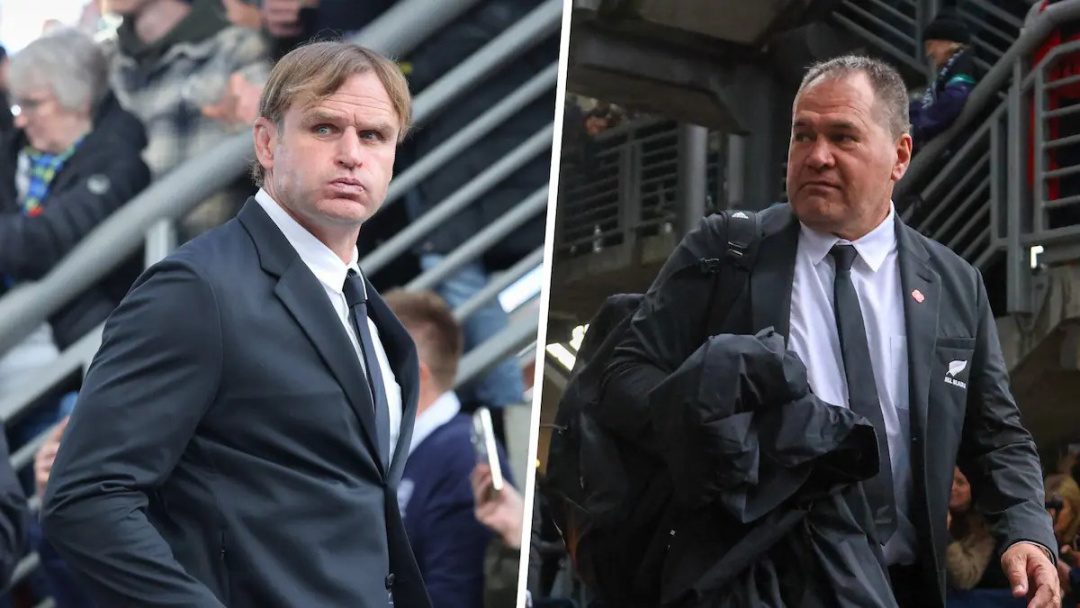
The All Blacks of 2026 are an entirely different team to the side they were in 2025. The arrival of Dave Rennie as head coach has brought a cultural reset, a tactical overhaul and a calm and clarity that was missing under Robertson.
Ioane is perhaps the most illustrative example of how the new regime has recharged veteran players and redirected them, with the 29-year-old outside back/midfielder cutting a relaxed and happy figure as he spoke to me in Bath.
“Yeah definitely,” he says to the question of whether he’s happier now than he was a year ago. “A lot more refreshed and clear would be two words, happy as well, happy yes, but more so refreshed and clear.
“Looking back a year now from how we finished in Wales, the team was in a different situation than we are now.”
Ioane’s improved mental state has been the gateway to him returning to the All Blacks a better player. He’s leaner, fitter and sharper and has become a regular on the bench after showing in South Africa that he’s rediscovered how to beat defenders.
So how does he feel about the Robertson era and the way he was treated? “It happens in high-pressure footy and I am not the only one that has had that issue,” he says.
“I don’t like to reflect too much on what has gone because it has gone and I am looking only forward because I am in a positive mindset.”
The difference in the All Blacks was also noted by some of the Scottish media last week in Edinburgh, where several journalists commented on how the atmosphere at the team-naming press conference had changed since last year.
In 2025, Robertson made a joke – or tried to – about a seemingly omnipresent bagpiper that had been busking outside the team’s hotel on the Royal Mile.
Robertson said when he was asked if the team had enjoyed being in the Scottish capital: “There is a guy on the corner with bagpipes for the last three days, I am not sure if he has intended to be there or not.
“I tell you what, it sounds like the same song, but it is not and I am not saying that … after a while they all blur together. But look you just feel it these people are round and you get pulled over and ‘can we have a photo?’. There is a real sense of the occasion.”
Robertson, it is understood, had told some of the All Blacks management before the conference that he intended to make a quip about the bagpiper, but he was strongly advised against it.
He was told it may cause offence and it was best to err on the side of caution. But the advice was seemingly ignored and while there was laughter from the assembled media, it was awkward rather than genuine.
This year, several Scottish journalists commented on the differences between Rennie and Robertson. In fairness, Rennie is known in the north and likely more comfortable among them, having coached the Glasgow Warriors for four years.
Rennie, it was noted, answered questions with clear, informative answers. He was relaxed and made appropriate light-hearted remarks – one in particular striking the right tone.
He was asked by a local journalist whether he could see current All Blacks assistant coach Mike Blair becoming part of the Scotland coaching team.
“No chance,” he replied with deadpan humour before going on to give a detailed, articulate explanation about what Blair brings to the All Blacks and why he’s so keen to keep him in New Zealand.
Rennie also retained eye contact and spoke with genuine feeling and care about the death of the All Blacks head of security Logan Cadwallader.
Robertson, on the other hand, had surprised the Scottish media pack by being nervous, twitchy and ill at ease. He chose to stand for press conferences in situations where other coaches would sit and in Edinburgh, like he did many other times, Robertson arbitrarily decided when they were over.
But most memorable for the Scots was that he couldn’t provide straight answers to simple questions, and they were surprised how the man differed so greatly from the myth that he’d been put in charge of the All Blacks because of his ability to connect and inspire.
One of the common topics of conversation that arose during the All Blacks’ series against South Africa was how different things would have been had NZR not decided to part ways with Robertson in early January and appoint Rennie.
Avoiding a potential disaster for the All Blacks
The consensus among rugby analysts is that it would have been a disaster – a genuinely catastrophic chapter where records would have tumbled.
And while it was a discussion point among media, so too was it something All Blacks management made passing reference to – in a puff-out-their-cheeks sort of way – to acknowledge they are relieved and happy about the new set-up.
That sense of relief has been even more palpable this week in the UK, with feelings heightened and memories triggered by being back preparing to play Wales – which was unquestionably the nadir of the Robertson regime 12 months ago.
One of the vaguest elements of the All Blacks under Robertson was the nature of the coaching set-up and the specifics about who did what.
This became a source of extreme tension between myself and Robertson in Cardiff last year. The week began with him providing an off-record briefing, at which my colleague Liam Napier asked him to detail how the set-up worked – primarily to understand how that would shape plans to replace departing assistant Jason Holland.
It was by no means the first time that I had said that Robertson, in winning the job, had pitched himself as a culture coach, responsible for theming campaigns, communicating one-on-one with players to manage their expectations and career progression, and that it was assistant coach Scott Hansen who was operating in the role most would recognise as the head coach.
But it was the first time I had been critical of the situation, writing: “It feels like the public have been mis-sold the truth about the All Blacks.
“There was huge public support for Robertson to be promoted to the All Blacks in 2023 because he’d earned the promotion through his success with the Crusaders.
“But it feels now like the people voted for a President who has handed the keys of office to the unelected Vice-President, without a mandate to do so.
“The situation – given results, performances and the division of labour – seems entirely unsustainable.”
I was told, the day before the game, that he was incensed by the presidential analogy and that I should avoid him until he’d cooled down. I suggested a better path was for him to behave like an All Blacks coach and talk to me directly – which happened the following day after the game.
We met in the underground concourse at the Principality Stadium – like some kind of Cold War spy exchange – where he proceeded to talk in what seemed to me to be an angry manner about his coaching credentials, making the point that he was the head coach.
I tried to tell him that I didn’t understand why, after me writing and him saying many times previously (and indeed only six days previously in our off-record briefing) that he was the culture coach and he was choosing to blow up about it now.
As I recall, he didn’t have an answer, and that whole episode highlighted the fragility and inconsistency of the regime. It was a sign of how Robertson had been able to present as high-performance genius in his sales pitch to win the job, and how badly the NZR executive and board who had signed off on Robertson’s appointment had underestimated the need for the All Blacks coach to have diverse life experience.
Again, in contrast to the Robertson regime, there is no doubt as to the fact Rennie is head coach of the current All Blacks team. His set-up is cleaner and without confusion.
One of the other big differences with the Rennie regime has been a resetting of relationships with the media, and the development of a culture of openness and transparency.
Rennie has made himself accessible and proactively hosted media informally in South Africa, with plans to do so again in the UK.
He’s put a heavy emphasis on relationship-building and creating high-trust environments in the hope that a better-informed media will better understand how the team is trying to play.
There are little things he has done – such as on Tuesday, when he came over unprompted to chat with media at the end of training, explaining why the team was preparing in Bath rather than Cardiff – that have been greatly appreciated.
Rennie has also distanced himself from the internal media projects that appear to run 24/7 within the All Blacks. He’s not opposed to the team’s content strategy or getting in the way of any of the long-form documentaries that are being worked on. He’ll contribute if it is deemed necessary, but otherwise he lets those charged with production operate without interference.
When I first came to Cardiff to cover an All Blacks tour for the Herald in 2005, Wales were Grand Slam champions and had provided 10 players to the British & Irish Lions tour of New Zealand earlier that year.
Both All Blacks head coach Graham Henry and assistant Steve Hansen had recently coached Wales and there was an obvious respect for the players.
But now Wales struggle to beat Japan and they are ranked 10th in the world – and many have blamed the decline on the decision to shift to regional franchises that didn’t have the history or in-built tribalism of the iconic amateur clubs such as Cardiff, Newport, Bridgend and Pontypool.
Whatever the truth, Wales sit as an example of where New Zealand could end up if they don’t get their professional competition structure right.
As the Herald has reported, the decision has been made to persevere with Super Rugby Pacific and the NPC as they are, but to amalgamate teams in the major urban areas.
There had been a provincial-led drive to scrap Super Rugby and instead build a 10-team professional competition in New Zealand.
But after rejecting that idea in October, NZR has now provided some financial details to the provincial unions as to what the cost of implementing that would be.
The national body estimates that the scrapping of Super Rugby in favour of a 10-team, New Zealand-only competition would add $36 million of player payments with only a $3m hike in total operating revenue.
It estimates broadcast income would suffer a significant drop to be valued at $44m, because the total number of games would reduce from 162 to 93 and the total number of weeks in which the season would run would go down from 33 to 20.
In total, NZR estimates a 10-team competition would run with a $42m deficit.
Insights from a leading rugby journalist
Gregor Paul is one of New Zealand’s most respected rugby writers and columnists. He has won multiple awards for journalism and written several books about sport.
Dave Rennie retains some starters but ushers in 10 changes to his squad for Wales.