Germany's Women's Basketball: A World Cup Success with Growing Pains
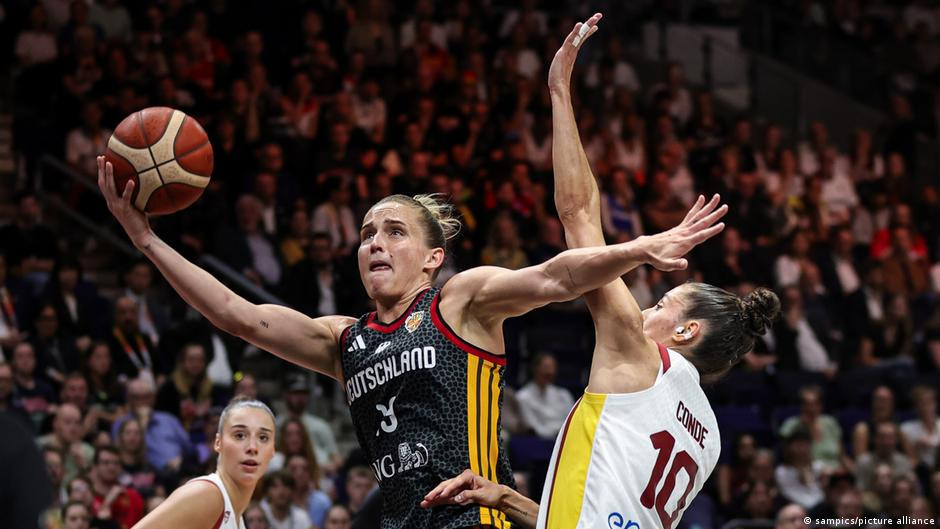
The Women's Basketball World Cup in Berlin concluded on September 13, showcasing the world's best players and thrilling fans. Germany's team, led by standout players Leonie Fiebich and Nyara Sabally, demonstrated significant improvement throughout the tournament, culminating in a stunning victory over European champions Belgium in the quarterfinals. However, the final weekend revealed that Germany still has work to do to compete consistently with the world's elite teams, as they lost to France in the semifinals and then fell to Spain in the third-place match. Despite these setbacks, the German squad viewed the tournament as a major success, with Fiebich acknowledging the team's current limitations but expressing optimism for the future.
"We simply aren't good enough yet," Fiebich stated after the loss to Spain. "We played the tournament with a lot of euphoria and beat the European champions, Belgium. But it's hard to keep overperforming. Still, we will get better."
Gear for the Game
Sponsor success. Continue reading:
The World Cup marked a significant milestone in the development of women's basketball in Germany. The team qualified for the Olympic Games for the first time in 2024 and achieved an unexpected gold medal in the 3x3 basketball event. At the 2025 EuroBasket, Germany's women finished fifth, and with the next EuroBasket on the horizon, they are poised to be strong medal contenders if they qualify.
Germany's head coach, Olaf Lange, emphasized the importance of using the team's recent experiences as motivation for improvement. "I think it's important to harness the pain the players are feeling right now," Lange said. "Because in our day-to-day work over the coming months and years, we need to improve individually. That requires a lot of motivation, and this pain acts as fuel for improvement."
The support from German fans was overwhelming, with approximately 230,000 tickets sold for the World Cup. While the tournament attracted some international fans, the majority of the crowd was made up of enthusiastic Germans, signaling a growing interest in women's basketball.
Challenges in women's basketball infrastructure
However, despite the national team's progress, the infrastructure for women's basketball in Germany remains inadequate. Most players from the World Cup squad currently play abroad, with Fiebich, Nyara Sabally, and others competing in the WNBA, while team captain Marie Gülich is set to join a club in Australia. Only a handful of players, such as Alexandra Wilke and Emma Eichmeyer, play in the domestic league (DBBL), which Lange describes as "semi-professional" and in decline compared to previous years.
"Back then, the top clubs had better structures than they do today—and we are in 2026. That says it all. Things are really going backwards," Lange lamented during his post-tournament press conference. He stressed the need for changes to ensure the national team's continued success, noting that without improvements in the league, sustaining their recent achievements will be challenging.
Ireti Amojo, who became DBBL president in March, is working to professionalize conditions within the league. She has proposed hiring full-time youth development coaches and increasing arena capacities to accommodate growing interest. Currently, many venues can only hold around 600 spectators, which is insufficient given the rising popularity of the sport.
Amojo expressed concern about the missed opportunity to capitalize on the World Cup's momentum. "We should have started five years ago so that we could say now: 'We are capitalizing on the momentum of the World Cup and ensuring that all these kids who have become basketball fans can play the sport in clubs across Germany,'" she said. "We are too late. We lack the structures to harness this interest and provide all the children fascinated by basketball with the opportunity, under perfect training conditions, to develop into the next Leonie Fiebich or Nyara Sabally."
Despite these challenges, Amojo remains hopeful that the World Cup will serve as a catalyst for future development in women's basketball in Germany. "It was the kind of proof we all needed, because people are quick to dismiss it, claiming that no one in Germany is interested in women's basketball. Now we've seen that people in Germany are interested in women's basketball," she concluded. "We already have a few levers we want to use to work on the structures. And this certainly shouldn't be the end of things.